Angola’s Institute for the Regulation of Petroleum Derivatives (IRDP) presented its strategy to expand the country’s fuel refining and storage capacity, aiming to achieve fuel self-sufficiency and reduce dependence on imports.
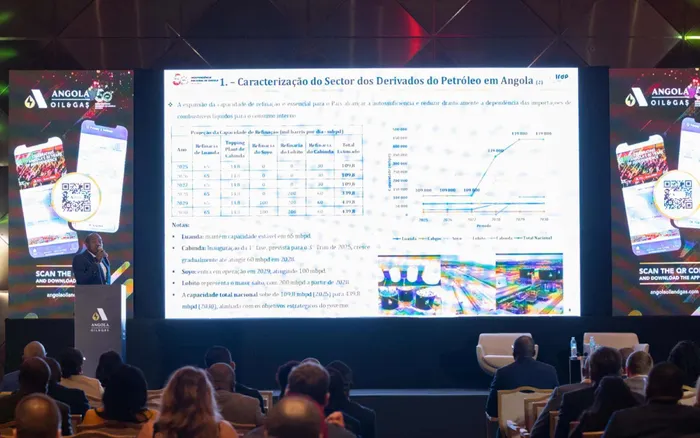
The strategy was detailed by Nelson de Carvalho, Director of the Department of Commercial Relations, Tariffs, and Prices at the IRDP, on September 2, during the “Investment Opportunities in Angola’s Downstream Sector” session held as part of the Angola Oil & Gas 2025 pre-conference events in Luanda. The session was sponsored by the IRDP.
“Investment in the development of Angola’s downstream sector is a vital engine for economic growth, diversification, and the strengthening of the country’s energy security. It can generate a multiplier effect due to its impact on the petrochemical industry,” stated the executive.
According to Nelson de Carvalho, Angola will expand the operational capacity of the Lobito and Namibe infrastructures by 2027, with additional developments also planned for the units in Cabinda, Soyo, and Moxico. These expansions are expected to increase the national storage capacity for liquid and gaseous fuels to 1.3 million cubic meters by 2027.
Furthermore, the future Soyo refinery is expected to add 100,000 barrels of oil equivalent per day (boe/d) by 2029, while the Lobito refinery, planned for 2028, is expected to contribute 200,000 barrels per day (bpd).
During the presentation, the executive also highlighted existing investment opportunities in the construction and operation of storage facilities and pipelines (oil and gas), fuel stations, LPG bottling plants, and lubricant production factories.